All Guides/culture
culture · 4 min read
Retiro Park: The Complete Guide
El Retiro in Madrid — the Palacio de Cristal, the rowing lake, the Rosaleda, opening hours, which gate to use, and how to pair the park with the Prado.
By Get Madrid · Updated September 9, 2026
What It Is
El Retiro — properly the Parque del Buen Retiro — is 125 hectares of formal gardens, lakes and woodland immediately east of the Prado. It began as the private grounds of a 17th-century royal palace and stayed closed to the public until 1868. Since 2021 it has been inscribed by UNESCO, together with the Paseo del Prado, as a World Heritage site.
It functions less as a tourist attraction than as the city's shared back garden: runners at 08:00, families at midday, drummers and buskers on Sunday afternoons.
The Things Worth Finding
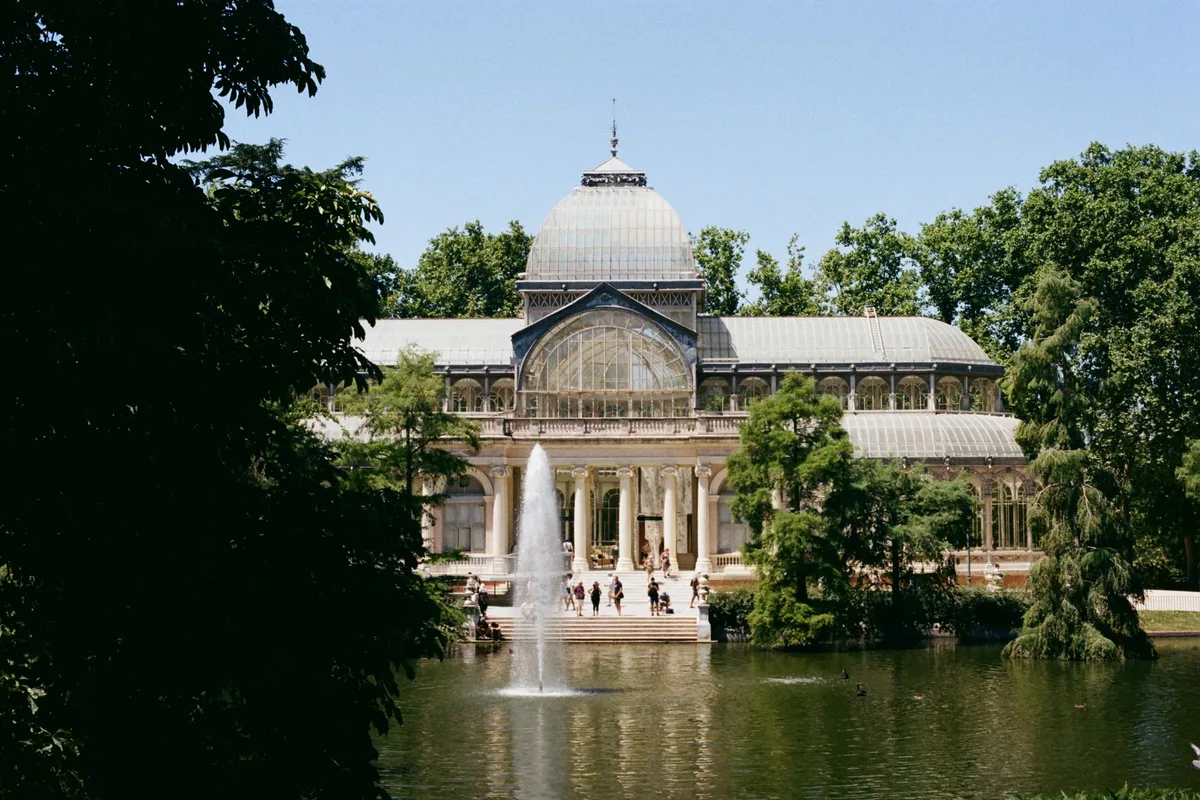
Palacio de Cristal. A glass-and-iron pavilion from 1887, built to house Philippine plants for a colonial exhibition and now used by the Reina Sofía for rotating art installations. Entry is free. It sits on a small lake at the park's quiet southern end, and it is the single most photogenic structure in the park — early morning light through the glass is the shot.
The Estanque Grande. The big rectangular boating lake, dominated by the Alfonso XII monument's colonnade on its eastern edge. Rowboats rent by the half-hour from the jetty; it's more physical than it looks and genuinely fun.
La Rosaleda. The rose garden, laid out in 1915, at its best in May and early June when it holds several thousand roses in bloom. Quiet even when the rest of the park isn't.
Palacio de Velázquez. The Crystal Palace's older brick sibling, also used for free Reina Sofía exhibitions and almost always emptier.
El Ángel Caído. A 19th-century statue of the fallen Lucifer — unusual enough as public sculpture to be worth the detour, and often claimed, with more romance than accuracy, to be the only public monument to the devil.
The Ahuehuete. Near the Parterre, a Montezuma cypress thought to be around 400 years old, one of the oldest living things in the city.
Which Gate to Use
The park has multiple entrances, and picking the right one saves fifteen minutes of walking.
- Puerta de Alcalá / Plaza de la Independencia (metro Retiro, line 2) — the grand northern entrance, closest to the boating lake and the Parterre. Best default.
- Puerta de España on Alfonso XII — the direct approach from the Prado, and the shortest route between museum and lake.
- Menéndez Pelayo side (metro Ibiza) — the eastern entrances, closest to the Rosaleda and the Ángel Caído.
- Atocha end (metro Atocha) — the southern corner, nearest the Palacio de Cristal, and the right choice if the glass pavilion is your priority.
Hours and Practicalities
The park opens early and closes at night, with longer hours in summer than winter — roughly 06:00 to midnight from April to September, closing around 22:00 in the colder months. Entry is free and always has been in the modern era.
There are cafés and kiosks around the lake and along the main avenues; prices near the Estanque reflect the location. Toilets exist but are sparse — use the ones in the Prado or CaixaForum if you're arriving from that side.
Sundays bring the biggest crowds and the best atmosphere: drum circles, tarot readers, puppet shows and impromptu football near the lake. Weekday mornings are the opposite — near-empty paths and joggers.
Combining It With the Museums
The Retiro sits at the top of the Paseo del Arte, which makes a natural half-day route. The Prado's northern entrance is a five-minute walk from the Puerta de España gate; CaixaForum and its vertical garden are ten minutes south along the same boulevard; the Reina Sofía anchors the far end at Atocha.
The efficient order, if you're doing both in one day: museum first while your concentration is fresh and the galleries are quietest, then the park in the afternoon when you want to be outside and moving. If you're timing the Prado's free evening window (18:00–20:00 Monday to Saturday), do the reverse — park in the afternoon, museum at six.
When to Go
Spring is the park at its best — the Rosaleda in bloom, mild temperatures, and the trees fully out. Autumn runs a close second, with the avenues turning gold through October and November. Summer afternoons are genuinely too hot for the open sections; go early or after 19:00 and stick to the shaded paths on the eastern side. Winter is clear, cold and quiet, and the bare structure of the formal gardens is easier to read without foliage.